
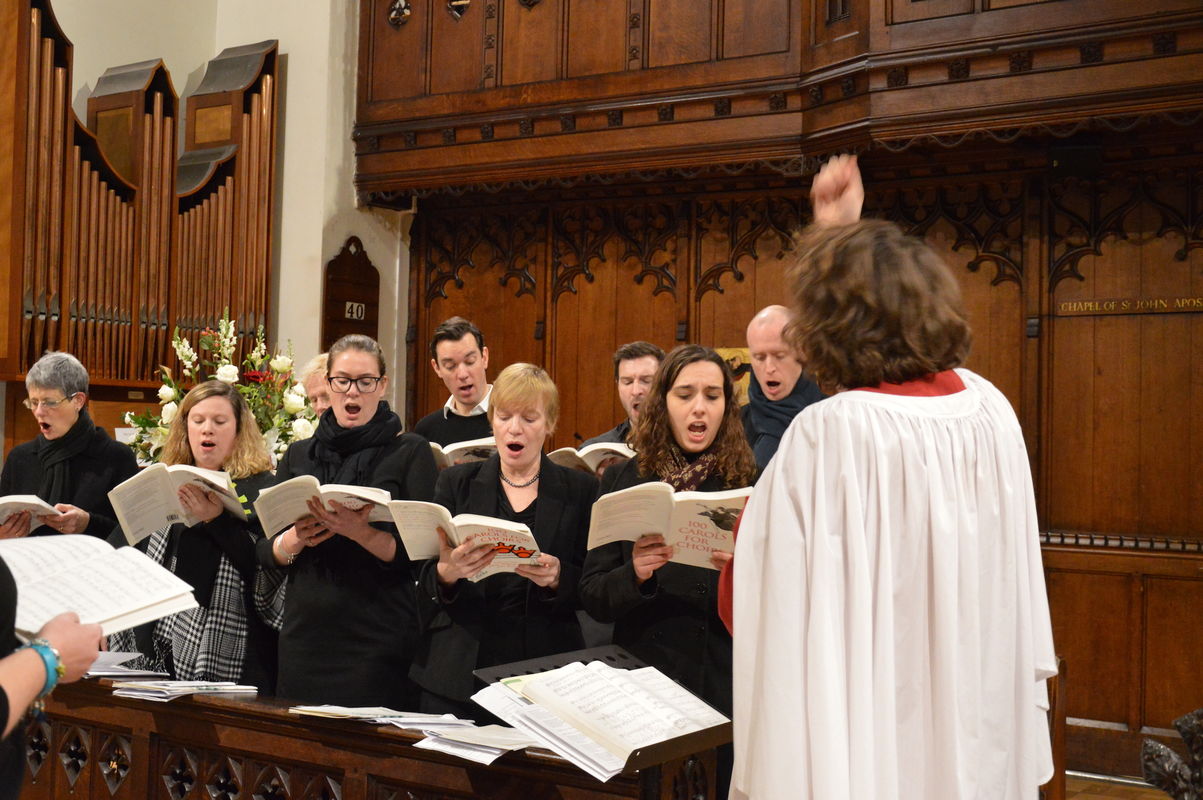
Are you the only scratch, non-professional choir that sings Evensong exclusively in London?
Yes!
Where are the farthest flung places your singers come from?
My original conception was a pan-East London church choir: and sure enough, people from Bow, Stratford, Plaistow, Woodford, Walthamstow and Hainault have come to take part, and have commented that such ambitious programmes of music wouldn’t be dreamt of at their local Parish church.
What I didn’t expect was that we have been joined by people from as far away as Ealing, Horndon-on-the-Hill, Amersham, Hertford and Wiltshire. One of our most unique and most appealing aspects, I think, is that we get fantastic results with very little commitment: we sing once every two months, we operate on a “sign up if you feel like it” basis, and we rehearse for no more than two hours for each service.
There are a huge number of people out there in London with an expertise which churches should be crying out for; but how many effectively turn these people – often busy professionals – away with demands for excessive commitment? The people who commit to singing at Christ Church week-in-week-out are of course the musical life blood of the church; but why couldn’t there also be a home for people who didn’t want to do this?
What kinds of jobs do people have? Is the Evensong Choir open to all?
From the top of my head, we count among our members: school workers, vet nurses, members of the clergy, lawyers, civil servants, scientists city workers, PR workers, and professional singers – though interestingly, the singers often come from non-Church backgrounds.
The issue of whether our one entrance prerequisite – strong sight-reading ability – favours those with a certain kind of background is important. Christ Church has begun working on this over the course of the last year by establishing a chorister school for children from the local community.
Where East London Evensong Choir is genuinely egalitarian is our conviction that a slightly out-of-the-way church in the East End should be entitled to expect the same quality of singing as at some of the well-endowed west London and city centre churches. Visiting organists who know the London church music scene well have commented that they have never heard of the church and hadn’t imagined that we’d have such a fantastic choir to offer.
How long has the choir been going for?
Our first service was in July 2016. Very are still very young! Our Epiphany Carol Service on January 8th was our fourth service.
Did you have any problems along the way in setting it up?
The single biggest challenge was getting it started. Starting a choir, I think, involves something between a lie and a dose of extreme optimism: if you tell enough good singers that there’ll be a good choir at a certain place and time and they believe you, you’re unstoppable; but if only a few do, you have a sticky situation on our hands! Luckily, many of the people who attended our first service became our most loyal members and we have consistently managed to field choirs of increasing size and quality. It helps that word is beginning to spread, with many of our singers inviting friends to join.
The other constant bugbear is the organ at Christ Church, which is not in the healthiest state – but the church has begun an ambitious fundraising campaign to help us sort this out.
How has the choir affected the church and its community as a whole?
To my mind, it has resurrected the practice of Evensong within Christ Church. When I joined the church in 2015, I can remember conducting Evensong with as few as three people in the congregation. At our Epiphany Carol Service, there were twenty-five in the congregation – and that number has been rising as word spreads about our choir.
Initially, there was some resentment from members of the Parish Choir about the idea of bringing in a semi-professional group to undertake what might have been one of the Parish Choir’s keenest responsibilities – and, although this didn’t stop me from moving ahead with the project, I found this very understandable, and it’s important for me to acknowledge this.
However, I think the existence of East London Evensong Choir has actually helped the Parish Choir to find a new lease of life. One on the one hand, people who have signed up to sing with East London Evensong Choir have gone on to sing with the Parish Choir, perhaps regularly or perhaps covering for the odd service, and this has been a useful way of attracting new “regulars”, which I didn’t expect at first. On the other hand, it also provides useful break and respite for the Parish Choir: a service “off” for them means more time to prepare fully and in a spirit of ambition for other services, and the huge load of Parish music-making, which generally involves five or six services per month, begins to feel shared.
What’s it like in the pub afterwards?
Very different. After a pretty focussed couple of hours – we rehearse without a break and we sight-read everything on the day – followed almost immediately by the service, the pub provides an opportunity to relax and get to know who you’ve been singing with! A lot of friendships have been formed this way, and one thing that often strikes me is the wide range of age groups socialising together. It’s good to see different people from different places united by the perhaps fairly niche common interest of church music.
What % are regulars and newbies each time?
That is difficult to estimate: I often joke that we need a Nando’s-style loyalty card to establish who has sung the greatest number of services! We have five members of the church’s Parish Choir – often the de facto section leaders, and particularly strong sight-readers – who are highly committed to us; and we have about eight people from outside the church who have sung three or four of our services so far, which makes for a pretty committed core, around which new members join or come to try us out once. Interestingly, the soprano section is the most variable and the alto section the most consistent in terms of membership.
How do you see your choir changing the musical scene in churches around London?
Apart from anything, I hope it injects a dose of optimism. Early in my time as Director of Music at Christ Church, I couldn’t see the point of doing a Choral Evensong. Leave it, I thought, to Oxbridge colleges or St. Paul’s or the largest Parish churches in wealthier areas of London. Why do we bother when only three or four people attend: why not focus on the much better attended morning services? And, with a magnificent but small Parish Choir, is it even feasible to work through a service which is designed to be sung by around twenty and can involve almost half an hour of solid singing? This put me on a collision course with some of the die-hard Even-singers: at first I thought they were unreasonable to demand such an ornate service from a church with limited resources; but in time, it struck me as sad that they couldn’t turn to their local Parish Church for the style of worship that they required, particularly given its long-rooted Anglo-Catholic style of liturgy, and I wondered whether there was more I could do.
Fast-forward to two months after the establishment of East London Evensong Choir, and a lady approached me from a church on the Essex border. Ten years or so ago, her church had surrendered Choral Evensong in the face of exactly the same pressures as I faced and even disbanded its choir; and she now saw Christ Church as a destination for the continuation of this tradition, which was very surreal – even humbling.
One day, perhaps I’ll get around to grudgingly thanking the choir members who put me on this course. It’s certainly worked out well.
Do people pay to take part?
Goodness, no! This choir represents quite a fightback against the idea that the surest way of establishing quality Evensong is to pay a professional choir: but the choir certainly don’t give us money. Currently, our only expenses in running an East London Evensong are the organist’s fee and a few quid for music hire. For an eighteen-strong Dec and Can sight-reading choir singing an Evensong with two anthems, that ain’t bad.
Could it provide a new stream of employment for young professional church music leaders wanting to use their church music training in a community-focused way?
I hope so – and I hope it starts a trend towards a little more entrepreneurship among church music leaders. I began my work at Christ Church with very little in the way of church music training, and I’ve often wished, while learning on the job, for a more conventional background in organ playing and choral conducting and the other technical skills required for a post like this. But how many churches have the reverse problem: an organist with plenty of initials after their name and not enough singers to form a choir? East London Evensong Choir hasn’t been the only change at Christ Church. As I mentioned earlier, we’ve formed a chorister school, serving children from the local area, and they now sing Mass once or twice per month at Christ Church. We’ve also restructured the work of the Parish Choir, recruiting new members and putting behind us a corrosive and unambitious practice of doing every service with “whoever’s free” – maybe two sopranos, one tenor and a second bass this week!? – and instead singing two or three services a month with the whole SATB choir present, allowing a real increase in the quality of music we sing.
Problems are there to be solved – and it’s imperative for trained church musicians that they are. Without people to bang the drum for Parish music-making and to show church leaders and the community that the continuation of the Anglican Choral Tradition is feasible and fun, the guitars will come out and organists will lose their jobs.
Churches in the British Isles who are organising similar scratch choir events (please get in touch if you know of one):
St. James and Emmanuel, Didsbury, Manchester


